

Digital Product Passports
Digital Product Passports, explained. Read one part by part.
Scan a garment's QR code and its passport opens: what it is made of, where it was made, its footprint and how well each fact is evidenced.
Digital Product Passport

Put it in your hand. This is the kind of code you would find on a label or hangtag. It opens our demo hoodie's passport.
Scan with your phoneTap to open
Three questions
Three questions. Ask them of any passport.
Here are the answers on our demo hoodie's passport. The footprint figures are worked out from the first two. The third tells you how far to rely on all of it.
- 01
What is it made of?
Each fibre and its share of the weight. Recycled and organic fibres are named as such.
- 02
Where was it made?
Each stage of production from fibre to sewing, and the place behind it.
On the demo hoodieFive stages across Turkey, China and Portugal, about 20,500 km of transport between them.
Read part 04 - 03
How do they know?
Whether each stage is estimated, stated, checked against documents or confirmed by an independent third party.
What the first two answers add up to.
8.5 kg CO₂-eq
About the same as driving 50.2 km in an average car.
6,160 L world-eq
Water consumed, weighted by local scarcity. It has no everyday equivalent.
The car distance uses the UK government's greenhouse gas conversion factor for an average car, about 0.17 kg CO₂-eq per kilometre. The water figure gets no equivalent because a scarcity-weighted litre is not a litre you could picture coming out of a tap.
In one paragraph
The data behind one product. Read from its label.
A Digital Product Passport (DPP) is a set of information about one product, read by scanning a data carrier, usually a QR code, on the product, its packaging or the documents that come with it. Under the EU's Ecodesign for Sustainable Products Regulation (ESPR), what a passport must contain is set product group by product group. The rules for clothing have not been adopted yet.
An ENVRT passport shows what a garment is made of, where each stage of production happened, its environmental footprint and how well each of those facts is evidenced. The address behind the code stays the same when the passport is updated, and each update is published as a new version.
On an ENVRT passport
Production stages, from fibre to assembly, each with its own level of evidence.
Impact figures: the carbon footprint and the water scarcity impact.
Levels of evidence, shown for every stage, from modelled to verified.
Read a real one
A live passport, part by part. This hoodie, version 15.
This is ENVRT's demonstration hoodie as its passport shows it today. Most ENVRT passports show these parts in this order, though a brand can choose to show less detail.
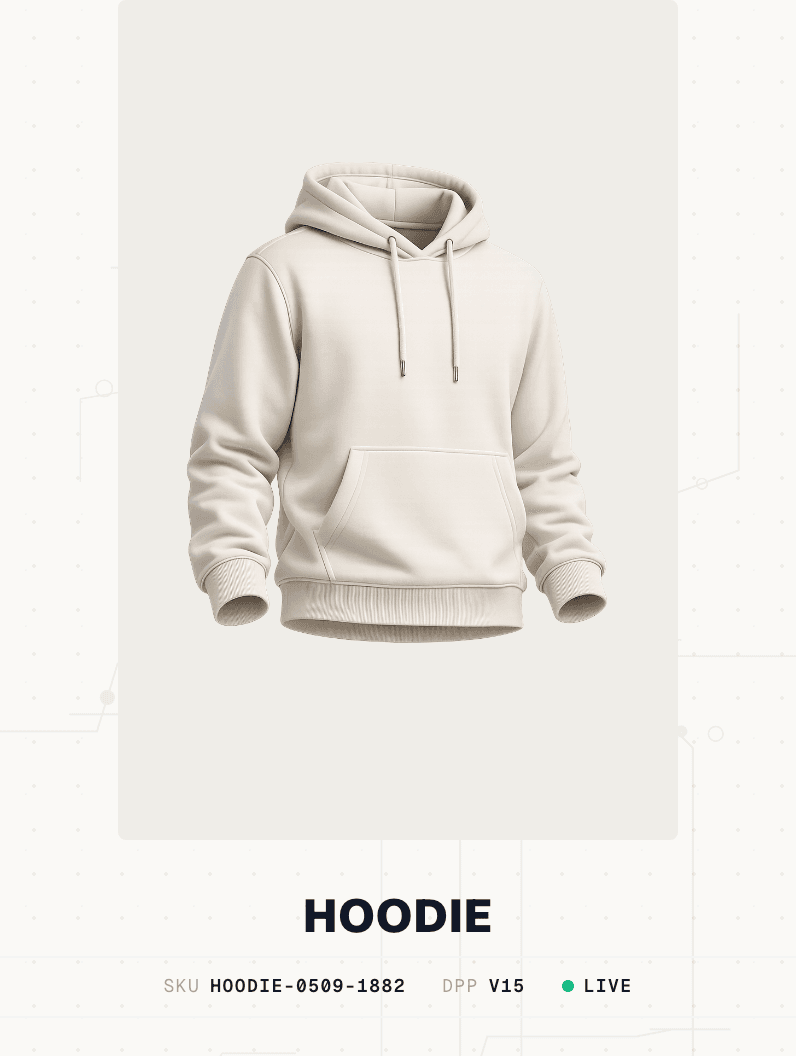
The top of the passport 01The product and its record
The product's name, its code and the passport's version. Every change to a passport publishes a new version, from a corrected weight to a new certificate. ENVRT keeps every earlier one. Live means the passport is published.
On this passportHoodieENVRTVersion 15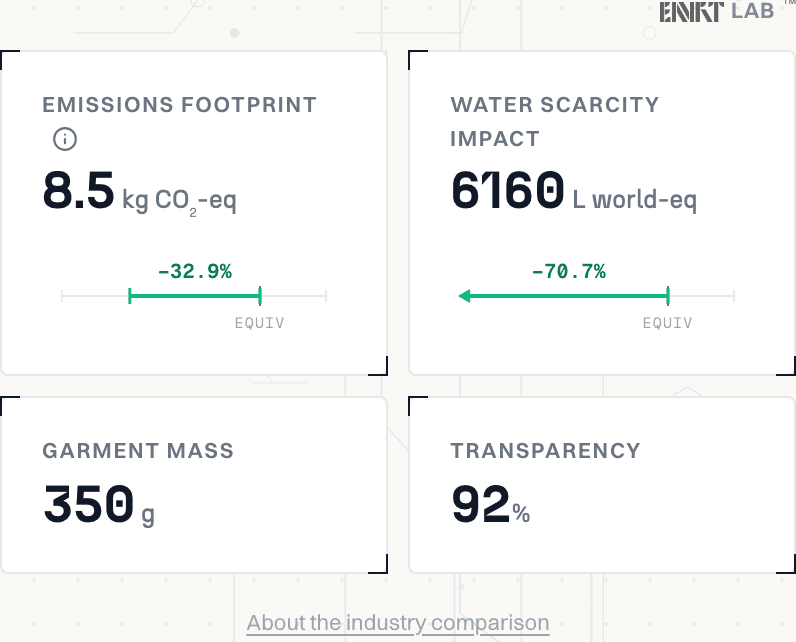
The headline figures 02The headline figures
Worked out from questions 01 and 02- Emissions footprint · kg CO₂-eq
- The greenhouse gases released in making the garment, expressed as carbon dioxide equivalent. It runs from producing the fibres to the finished garment, and includes trims such as zips and buttons and the transport between production sites. Where the brand records the journey onward from the factory, that is included too. Washing, wearing and disposal are not. As a rough guide, each kilogram is about the same as driving 5.9 km in an average car.
- Water scarcity impact · L world-eq
- The water consumed in making the garment, weighted by how scarce water is where it was consumed, using the AWARE method. A litre consumed where water is as scarce as the world average counts as one litre, and a litre consumed where water is scarcer counts as more. It measures pressure on water, not the litres used.
- The percentage and EQUIV
- How the garment compares with a conventional fast-fashion equivalent: a reference garment of the same type that ENVRT maintains to reflect typical conventional production, restated at the same weight. Both are calculated with the same method and data, and the comparison is recalculated whenever the passport's figures are. It is not a comparison with any named product or brand.
- Transparency · %
- ENVRT's score for how much of the supply chain is disclosed and how well it is evidenced. A stage scores more when it names its country, region and factory. It scores more again when that information is supported by documents or a certificate. A stage that had to be modelled adds nothing. Supporting evidence, transport detail and certifications add points on top.
- Garment mass · g
- The finished garment's weight. Every figure is calculated for this weight.
On this passport8.5 kg CO₂-eq, 32.9% below the equivalentAbout 50.2 km in an average car6,160 L world-eq, 70.7% below350 g92% transparency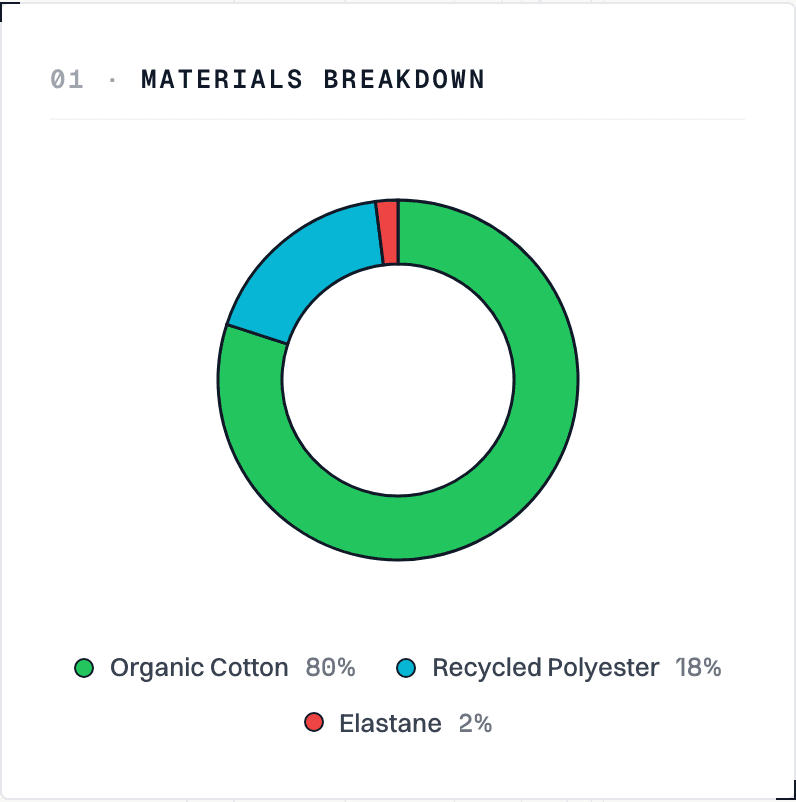
Materials breakdown 03What it is made of
Answers question 01Each fibre's share of the garment by weight, as on its composition label. Recycled and organic fibres are named as such, because they carry different figures from their conventional versions.
On this passportOrganic Cotton 80%Recycled Polyester 18%Elastane 2%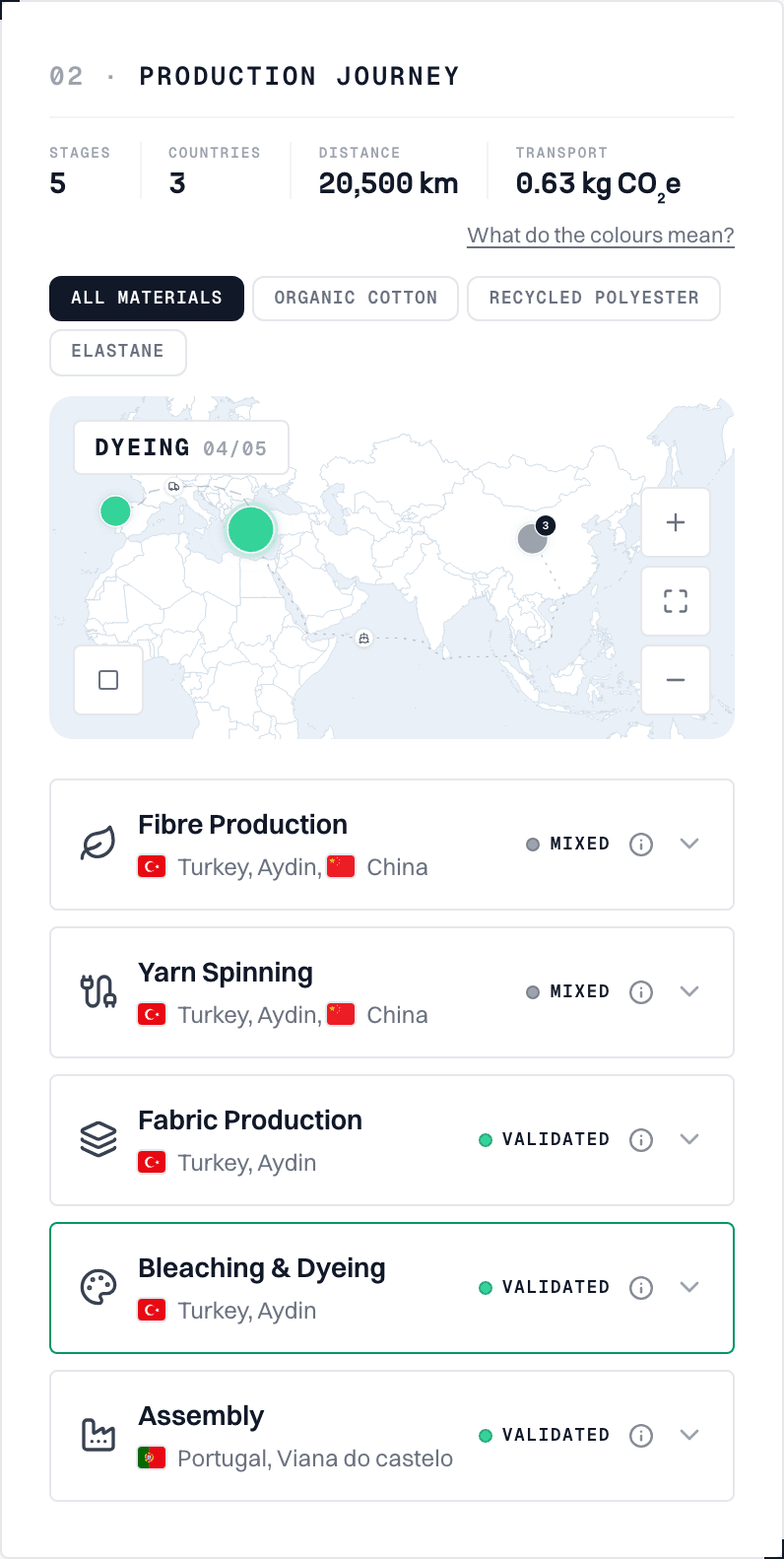
The production journey 04Where it was made
Answers question 02Each material follows its own route through five stages: fibre production, yarn spinning, fabric production, bleaching and dyeing, then assembly. The map shows each route and the list beneath it names the place behind every stage. The emissions of that transport are already counted in the headline figure.
On this passport5 stages3 countries20,500 kmFibre from Turkey and ChinaAssembled in PortugalEach stage carries a level 05How well each stage is evidenced
Answers question 03Next to every stage sits a level. It describes the evidence behind that stage's data, not the product itself. It matters as much as the figure. Where a stage had to be modelled, the passport says so.
- VerifiedConfirmed by an independent third party, such as a certification body.
- ValidatedChecked by ENVRT against supplier documents.
- DeclaredStated by the brand or its suppliers, without supporting documents.
- ModelledNot known for this product, so estimated from typical industry data.
- MixedMore than one level applies here. Open it to see each one.
On this passportFabric, dyeing and assembly validatedFibre and yarn mixed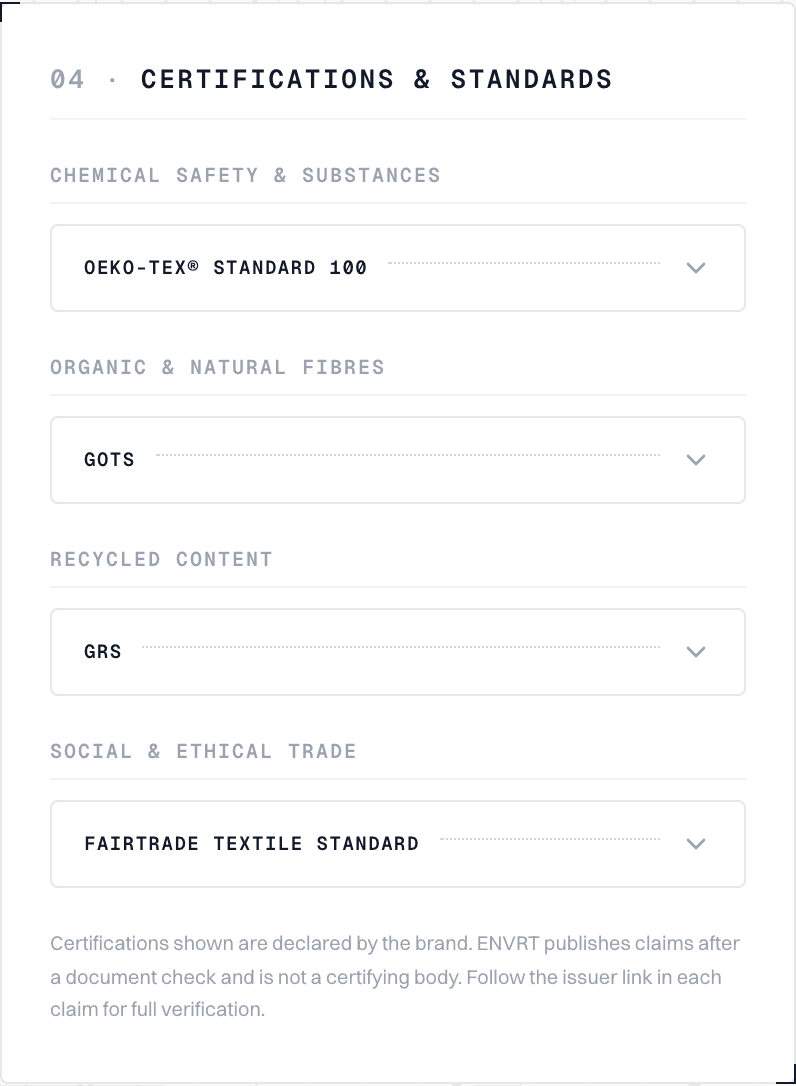
Certifications and standards 06Certifications
Answers question 03Certificates a brand holds for a product, such as GOTS for organic fibre or GRS for recycled content. ENVRT shows a certificate after checking its document and stops showing it once it passes its end date. ENVRT is not a certification body, so follow the issuer link on each certificate to confirm it with the body that issued it.
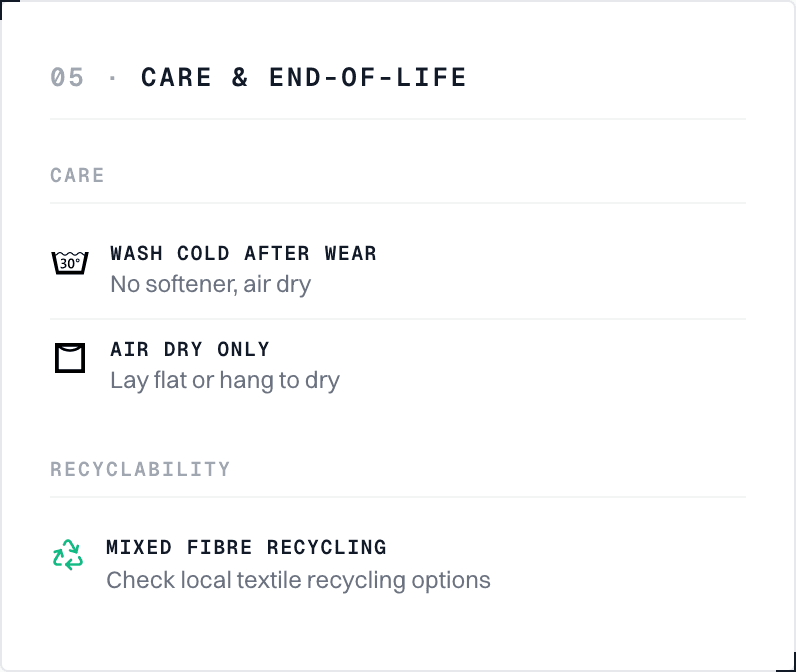
Care and end of life 07Care, end of life and questions
How to wash and dry the garment so it lasts, and what to do with it when you are finished with it. Below that, a form sends a question or feedback straight to the brand.
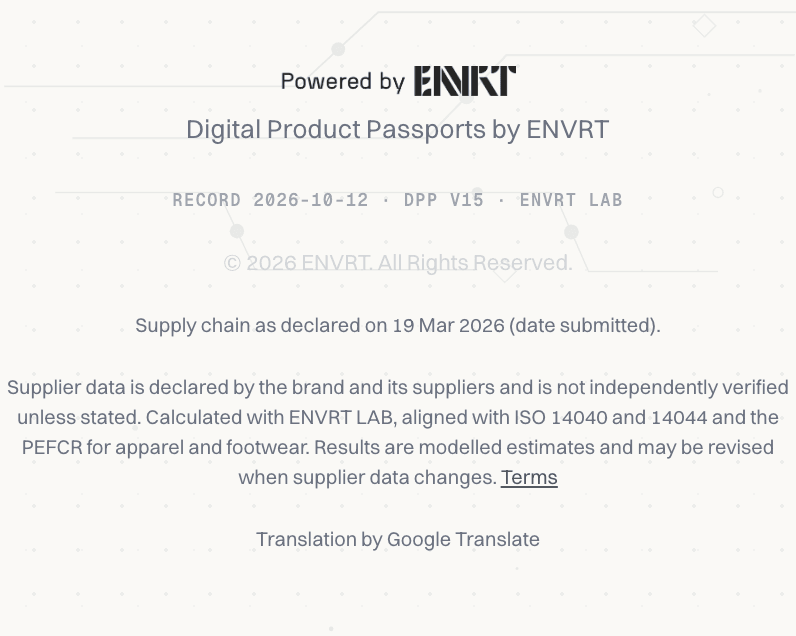
The small print 08The small print
Answers question 03The passport's record: its date, its version and the date its supply chain was declared. Then the standards the calculation is aligned with (ISO 14040 and 14044, and the PEF category rules for apparel and footwear), the engine that ran it (ENVRT LAB) and which parts have been independently verified. When a supplier sends better data, the figures are recalculated and published as a new version.
Before you rely on it
What a passport tells you. And how to read it.
It describes the design, not your unit
An ENVRT passport covers every garment made to one design. ESPR allows passports at model, batch or item level. Each product group's rules will set which applies. Colourways share a design's figures because the fibre, factories and process are the same.
Calculated for each garment
Each figure is a life cycle assessment of this garment: its materials, weight and supply chain, with typical industry data wherever a stage is not yet known. It is aligned with the EU's Product Environmental Footprint rules. Better supplier data sharpens the figures, and each update is published as a new version.
Being calculated means new figures are coming
When a product's materials, weight or garment type change, its figures come off the passport until they have been recalculated. You see this rather than numbers worked out for a different product.
Impact figures
Being calculated
ENVRT is calculating this product's emissions, water use, materials and supply chain. They appear here once confirmed.
A record, not a label
A passport records what was declared and how well each fact is evidenced. It does not certify the brand or the product, and a lower figure is not a claim that a garment is sustainable.
The brand is responsible for it
Under ESPR, the company that places a product on the EU market will be responsible for its passport. The brand chooses some of what its passports show, such as factory names. ENVRT calculates the figures, checks certificate documents and publishes the passport.
Not every part will be for everyone
ESPR lets each product group's rules decide who can see which information, so parts of a future clothing passport may be reserved for authorities, repairers or recyclers. Everything on an ENVRT passport today is public.
The rules behind it
Rules planned for 2027. Supplier data takes longer.
A clothing passport requirement will come from ESPR through a delegated act for textiles. The Commission plans to adopt it in Q4 2027 (an indicative date), and that is when the requirements stop moving. Its rules then apply after a transition of at least 18 months from the act entering into force. Gathering supplier data across a season takes longer than the time left before adoption, so the data is the part to start now. Passports published today, including ENVRT's, are voluntary.
- 20 Jul 2026
The EU's DPP registry opened. It records each passport's identifier and address for authorities. The passport itself stays with the company responsible for it.
- 27 Sep 2026
EU rules on environmental claims apply. A generic claim such as "eco-friendly" is banned unless the brand can show recognised excellent environmental performance.
- Q4 2027
Planned adoption of the textile delegated act, which will set what a clothing passport must contain. The date is indicative, and its rules apply after a transition of at least 18 months.
For brands
Want passports like this? One for every product.
Brands send their product and supplier data. ENVRT maps the supply chain, calculates each garment's figures and publishes its passport, ready for a QR code on the label, hangtag or packaging.
Calculated per garment
Carbon and water for each product, from its own materials and supply chain.
Evidence on show
Every stage carries its level, so shoppers see what is checked.
An address that does not change
The QR code keeps working when the data behind it is updated.
Questions
Reading a passport, answered
A Digital Product Passport is a set of information about one product, read by scanning a data carrier, usually a QR code, on the product, its packaging or its documents. Under the EU's ESPR, each product group's rules set what a passport must contain and who can see each part. The rules for clothing have not been adopted yet.
One last thing
Five styles in. Live passports out.
Impacts, live passports and a walkthrough for five of your styles. No card required.