

For manufacturers
A passport for every garment you make.
We set up your styles once. You send orders as you do today. Every garment leaves with its own passport and QR code.
Why now
Your clients now need proof.
The questions brands now answer about their garments are questions about how those garments were made.
Already
Brands are asked for product data
When a retailer or marketplace asks a brand what a garment is made of, where it was made and what its footprint is, the brand turns to the factory that made it.
Since 27 Sep 2026
Environmental claims need evidence
EU rules on environmental claims now apply. A generic claim such as “eco-friendly” is banned unless the brand can show recognised excellent environmental performance, so brands want figures they can stand behind.
Planned for Q4 2027
Passports are planned for clothing
The EU plans to adopt the rules for textile passports in Q4 2027, an indicative date, with obligations at least 18 months later. Gathering data across a supply chain takes longer than that.
EU rules follow where a garment is sold, not where it is made. We work with factories in any country.
Where it starts
You already hold the data.
It sits in the documents you make every style from. We turn them into the passport, so your client has no one to chase.
- Your document
- On the passport
- Tech pack
- Fibre composition
- Spec sheet
- Weight per size
- Mill documents
- Yarn and fabric route
- Process records
- Dyeing and finishing
- Supplier list
- Where each step happens
- On file
- Fibre and process certificates
What you get
We do the data work.
Its own passport and code
Every garment gets its own passport page and QR code.
Your styles, set up once
We build each style's passport from your documents. You check it.
Your orders, as they are
Send orders through your login or by email. We check each one.
Codes ready to print
A data file for your label printer, or print-ready sheets.
Your factory stays private
Your name stays off public passports unless you choose to show it.
A dashboard for each brand
Your clients see their passports at no cost. You stay their supplier.
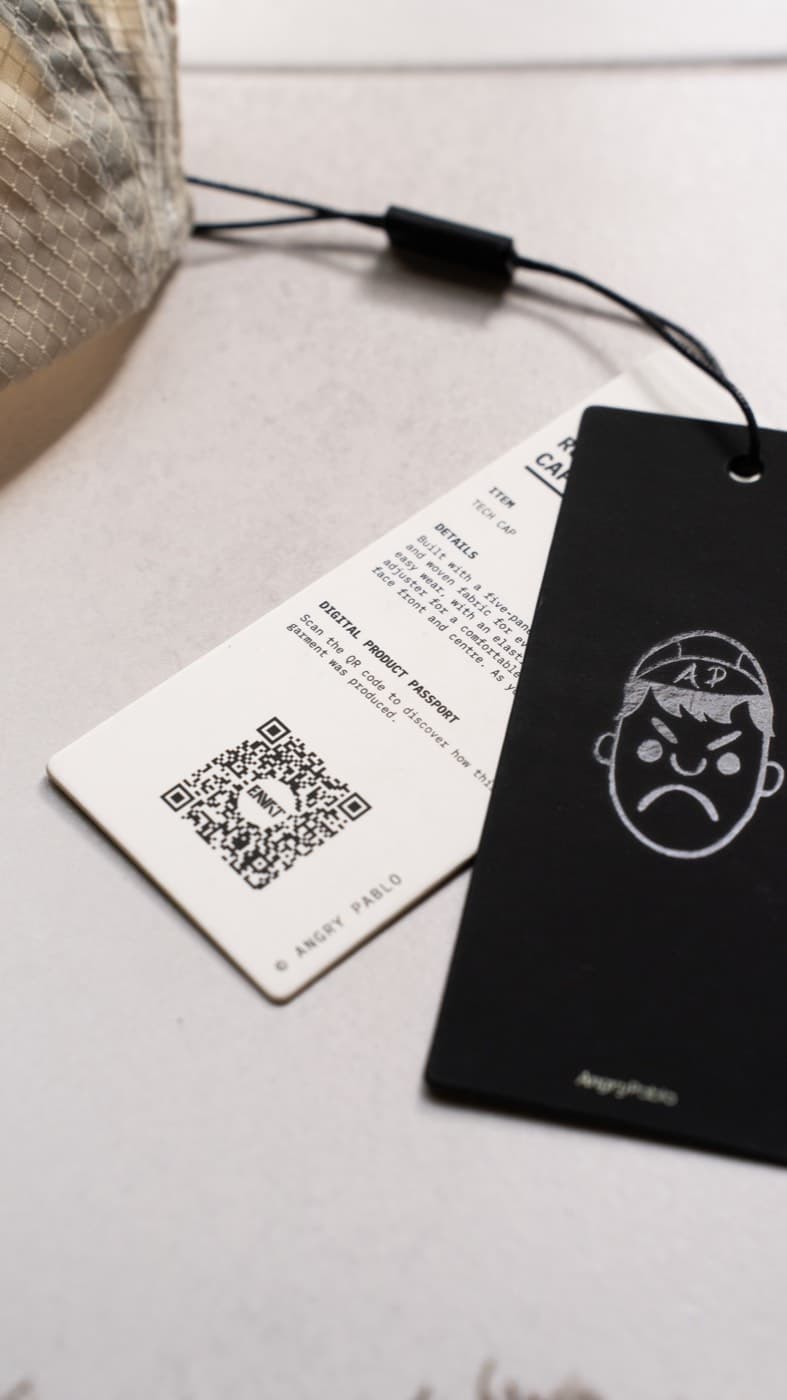
On the label
The code goes on your label.
Each code opens one garment's passport, with its colour, size and batch. You or your label supplier print it, the way you print labels today.
- Format
- A data file for your printer, or print-ready sheets
- Where it goes
- Care label, hangtag or packaging
- Code life
- Made to last as long as the garment
How it works
From tech pack to label.
- 01
Set up your styles
Send the tech pack and spec sheet for each style. We build its passport and you check it.
- 02
Send your order
Style, colour, size and quantity, through your login or by email. We check every order before any passport is made. No brand yet? Every garment still gets its passport.
- 03
Label every garment
Print the codes on your labels. Each one opens that garment's own passport.
Reorders reuse the same setup. Each order is recorded as its own batch, with its own dates.
A live passport
Scan a real passport.
Every passport answers the same three questions, from what the garment is made of to the evidence behind its figures.
Open a live passport
FAQ
Practical questions.
No. We give every garment its own code. If a client uses GTINs, we record them against each colour and size.
Start small
Start with one style.
Pick one style or one client's order. On a 30-minute call we show you the whole route on a real garment.